
Accessory Dwelling Units in Adams County
Background
Adams County adopted regulations in 2019 allowing Accessory Dwelling Units (ADUs) where single-family homes are allowed. While Adams County is not subject to HB24-1152, it adopted changes in 2025 to align its regulatory framework with the new law that applies to many surrounding cities and counties.
A general goal of ADUs is to support an avenue for increasing housing affordability by allowing for more flexible development on an existing single-family property that has room to add an additional smaller living space to it. The County supports adding ADUs where possible and this webpage has a list of questions designed to serve as a starting point for those thinking of adding an ADU to their property.
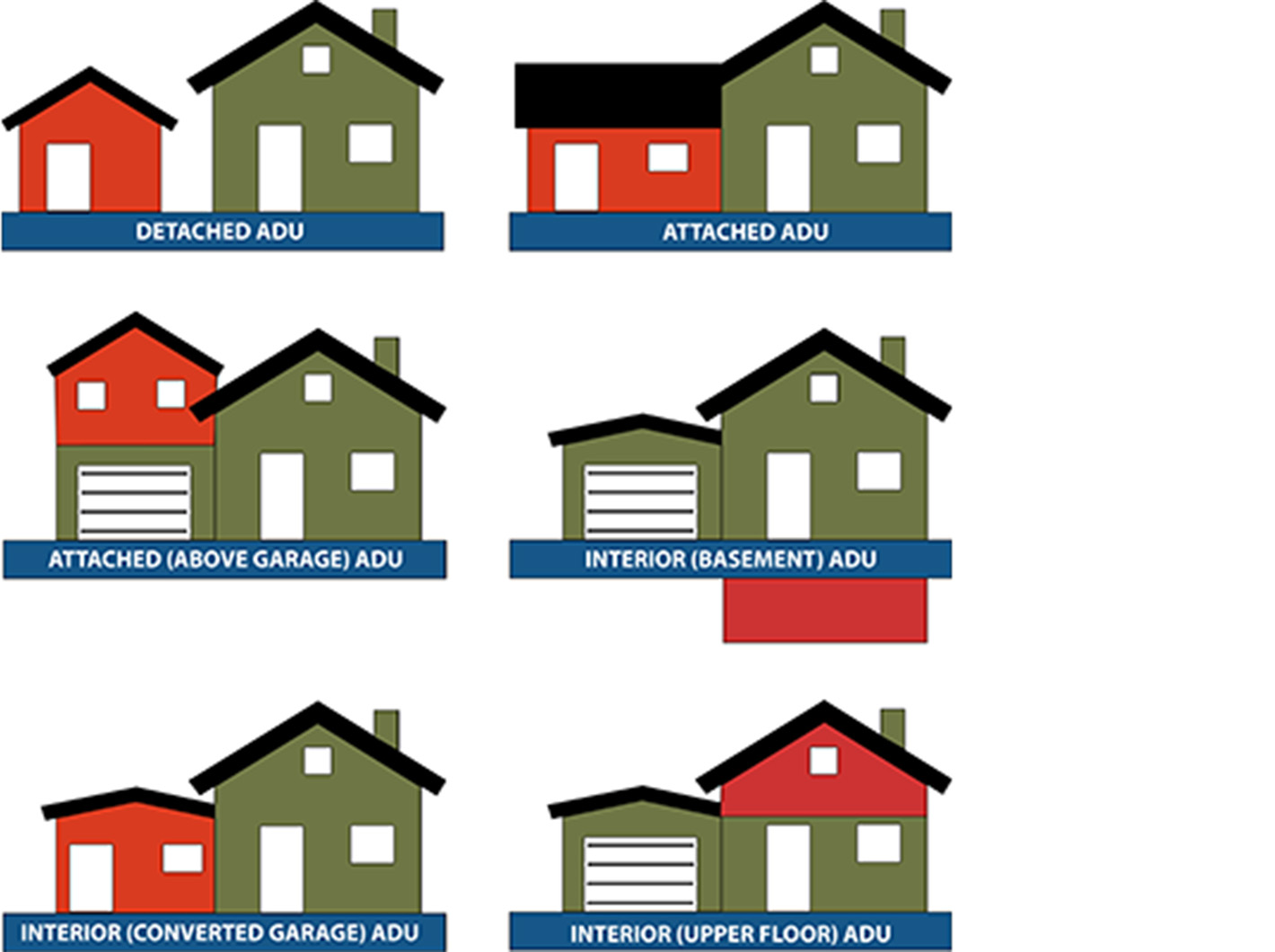
Accessory Dwelling Unit Basics
An ADU is an independent living space on the same lot as a detached single-family home, generally smaller than the primary home. ADUs can go by different names (for example a carriage house, mother-in-law suite, etc.) and be a part of the main home, a standalone separate structure, or part of a separate structure.
ADUs have the potential to increase housing affordability both for homeowners and tenants by creating a wider range of potential housing options within a community. Adams County regulates ADUs to:
- Provide homeowners with an opportunity for companionship and security.
- Better utilize existing infrastructure and community resources.
- Provide a housing type that responds to changing needs and lifestyles such as small families, retirees, or caretakers.
- Add to the county’s stock of affordable dwelling units.
- Protect neighborhood character and stability by ensuring that visible ADUs are compatible with surrounding land uses.
An ADU typically has its own entrance, separate from the main home, as well as its own kitchen.
Types of ADUs:
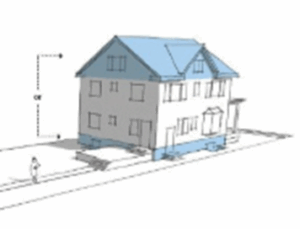
Attached internal, located withing the principal dwelling, such as an attic or a basement.
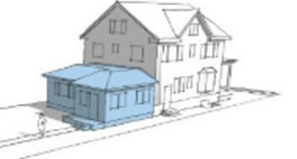
Attached via addition to principal dwelling.
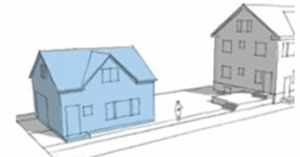
Detached, stand-alone structures, this includes dwelling units within a garage, barn, or modular and manufactured homes.
ADUs are permitted on an existing legal lot as an accessory use to a single-family home in any zone district. You may reach out to the Adams County Planner of the Day to inquire about your zone district and relevant setback regulations: CEDD-Plan@adamscountyco.gov.
An ADU cannot be sold individually through any process and is accessory to the existing home.
It depends! The minimum size for any ADU is 500 square feet. Otherwise, ADUs cannot exceed 40% of the home’s floor area or 750 square feet (whichever is greater), and the maximum size for a detached ADU is 1,500 square feet.
Bonus: What is residential floor area? Any finished living space that is at ground level or above, not including basements.
For any home 1,875 square feet or less, you can build an ADU between 500-750 square feet, and homes with more floor area may be able to build a larger ADU.
This website has the most information in one place about ADU regulations: Section 4-03-03-02-01 of the Adams County Development Standards and Regulations. For more information on how to apply for a building permit for an ADU, please also see the step-by-step process outlined below or the Building Permit ADU checklist.
Step-by-Step Process
Planning and Budgeting
- Contact the Adams County Community & Economic Development Department to talk through the potential idea of building an ADU on your property so we can identify potential property-specific concerns.
- Create a budget for your ADU depending on what size and type makes sense for your property.
- Contact your local fire district to see if they have any requirements for your proposed project.
- Contact your local water and sanitation district OR (if on septic and well) the Adams County Health Department and Colorado Division of Water Resources (DWR). Utility districts have tap fees while the Health Department and DWR may have more site-specific constraints for accommodating an accessory residence.
- Contact utility providers such as gas and electric as providers may have other impact fees.
- Contact the Adams County Community & Economic Development Department as well as utility providers to ensure your new unit is properly addressed for service.
- Review Building Permit Checklist for ADUs. Make sure you have all necessary documents complete and ready for submittal, such as engineered plans, site plan, etc.
- Review ADU Land Use Regulations to ensure compliance with county standards.
Submission and Payment
- Create an E-Permit Center account. If you need help, call 720.523.6800 or visit in-person at the Adams County Government Center, 4430 S. Adams County Pkwy., Brighton.
- Fill out an application within the E-Permit Center.
- Pay Plan Review Fee.
- Upload all documents and submit. Our initial review is 15 business days.
- If needed, respond to all outstanding comments in completion and resubmit with a five-business day review period.
- Repeat, if necessary.
- Permit approval! Pay building permit fee and zoning review fee as well as potential Traffic Impact Fee.
- Print permit card and approved files.
Construction and Certification
- Build or hire contractors to build your ADU as designed and approved.
- Begin construction! Any listed contractors and subcontractors must be licensed with Adams County.
- Schedule and complete inspections as needed with a 48-hour timeline.
- Request Certificate of Occupancy with E-Permit Center.
- Enjoy your new ADU!
Frequently Asked Questions
Yes. If an existing ADU was not created through a building permit, a building permit would be required to permit the ADU and make sure that it meets current standards.
It depends! ADUs generally follow accessory structure standards in the zone district they are in. The ADU-specific standards that replace general zoning regulations are the following:
- ADUs can be up to 25 feet in height, measured to the roof mid-pitch.
- Detached ADUs must be set back 10 feet behind the front structure line.
- ADU floor areas count towards principal structure coverage, not accessory structure coverage.
- Minimum rear setbacks shall not be greater than those that apply to other accessory structures in the same zone district or five feet, whichever is greater.
ADUs must be designed consistently with the color, façade, roof pitch, siding, lighting, and windows of the existing home. An aesthetic goal of ADUs is to reflect the existing development on a property as well as surrounding context.
An ADU can be a part of the existing home, a new structure, or part of a new structure. A new structure could be modular construction or prefabricated (manufactured homes) as long as the ADU is placed on a permanent foundation and connected to metered utility services.
Yes, a building permit is required to ensure that the modular ADU complies with zoning regulations, building codes, and minimum design criteria.
Yes, with conditions. Barndominiums are popular topics of conversation, where an accessory structure like a barn also includes a residential living space. An ADU may take up part of an accessory building and will still have to meet all the relevant performance standards for approval. For example, an ADU for a home less than 1,875 square feet in floor area may take up 500-750 square feet of a larger accessory building that is used for other purposes. It cannot take up more space than the regulations would allow. A similar example of this type of space usage would be allowing for an ADU on the top floor of a garage; the ADU is in an accessory structure and takes up part of the building, but not the entire building.
One off-street parking space needs to be designated for an ADU in addition to whatever is required the primary home. A new parking space would need to be constructed if:
- The property is in a zone district that requires parking for the primary home.
- There is not an existing parking space on the property.
- The property is on a block where on-street parking is not allowed.
If you are in a water district, you will need to provide a will-serve letter from that water district that specifically acknowledges they will provide water service to the additional unit on your property, as well as sewer if applicable.
- It is important to connect with a water district before putting together plans for an ADU. Tap or impact fees for adding more use to infrastructure may be a large expense in your budget and knowing how much it will cost before you embark on cost estimates will be important for your planning.
- You will also want to contact your relevant fire district to make sure you are aware of all requirements that they may have for a new residential space. A sprinkler system may be required.
If your property uses a residential water well, you will need to provide a well permit that shows the well can support multiple units and demonstrate that those units are not already being served by that well.
If your property uses a septic system, you will need to provide a septic permit specific to the ADU or an updated septic permit from the existing one to demonstrate the additional bedroom(s) is accounted for.
No. There can only be one ADU for a primary single-family home on a property. Accessory building sizes may also be further restricted by zone district depending on other buildings on the property.
Contact the E-Permit Center at 720.523.6800 or epermitcenter@adamscountyco.gov to talk to the Planner of the Day. You can also contact CEDD-Plan@adamscountyco.gov or the Building Safety team for questions about ADU regulations and requirements and how an ADU might work for your property.
Your site plan should show all setbacks from all structures (existing and proposed) to all property lines, other structures, wells, septic tanks, and leach fields, if applicable. Having a detailed site plan is important for moving through the building permit process smoothly. The site plan can be completed by anyone as long as it is detailed, clear, and accurate.
ADU permit applications generally require Colorado-registered design professional stamped plans. The Adams County Building Safety team is available to answer questions about the required items. A submittal checklist of requirements can be found on the Adams County website. The Engineering team can also answer questions about requirements if you need to acquire an access permit.
ADU structural and architectural plans will need to comply with the international building codes and minimum design criteria adopted by Adams County. The plans should demonstrate that the ADU will match the style of the principal dwelling.
Please refer to our development and building fee schedules on the E-Permit Center. Building Permits fees are based on job valuation, which includes labor and materials. For questions, please contact the E-Permit Center at 720.523.6800 or epermitcenter@adamscountyco.gov.
It depends! There are 10 fire districts that serve unincorporated Adams County. Each district is responsible for enforcing the International Fire Code, plan review, and inspections. For more information, please reference Adams County ordinance 12 and contact your local fire district. Adams County will review P2904 systems.
Yes, an ADU can act as a short-term rental unit. As of October 2025, the county does not have regulations related to short-term rentals unless any unit proposes to host 12 or more people. While the county does not currently have those regulations, it is anticipated to adopt regulations at some point, and if/when those regulations are adopted, any existing short-term rental property would be required to come into compliance with any new rules and standards.
No, a property owner does not have to live on-site in order to build an ADU.
No, a lot cannot be subdivided to sell an ADU independently of the primary home. The Adams County Development Standards and Regulations state the purpose of an ADU is to be an accessory use/structure to a principal dwelling unit and an ADU shall not be platted for individual sale through the condominium platting process or otherwise.
Need more information?
Please contact the Planner of the Day* at 720.523.6800 or cedd-plan@adamscountyco.gov.
Si necesita ayuda en Español, visite nuestro nuevo correo electronico creado para ayudarle mejor. CEDEspanol@adamscountyco.gov
* The information and recommendations provided by the Planner of the Day are intended for general informational purposes only and are based on the facts presented to this office and the regulations in effect as of today’s date. Any action taken in reliance upon their advice is at the addressee’s own risk. For formal guidance and official County positions, final action on a completed application is required. To start the process, please fill out a zoning verification or conceptual review meeting application through the ePermit Center.
Ready to Apply?
If you are ready to apply, you can create an account and file your application here.